OCTOBER2011 COALITION TO OCCUPY FREEDOM PLAZA
IN WASHINGTON, DC BEGINNING OCT 6th
IN WASHINGTON, DC BEGINNING OCT 6th
www.VetSpeak.org


 |
| Watermelon Slim (VVAW) rallies the troops |
 |
| Mike Hearington (VFP), Zach Choate (IVAW); CDn' at The Fence |

.jpg)
.jpg)
 The sight on Main Street of M113 APCs with top-mounted machine guns trailing live ammo belts followed by National Guardsmen with 10-inch-long bayonets protruding from their M1 rifles marching towards my campus sent me into knee-buckling dismay and anger. Two days later, after numerous futile attempts to disperse angry crowds of students chanting, “Guard off campus,” the unit’s Troop G regrouped at the top of a hill next to Taylor Hall, took up firing positions at the order of “Guard, prepare to fire,” and then opened up for thirteen seconds on a crowd of unarmed students. Most of their sixty-seven rounds went over heads, but fourteen found their targets, killing four and wounding nine, one of whom never walked again.
.jpg) Laurel Krause and her 84-year-old mother, Doris, also bear the scars of losing their 19-year-old sister and daughter, Allison, a committed peace activist and Kent State student who was also killed that day. Laurel, who was just 15 at the time, told us she has PTSD from the trauma of having a loved one so senselessly and suddenly lost to them forever. Knowing that many others—townspeople, University administrators, students and their families, Vietnam veterans, Guardsmen, and police—still carry deep grief, anger, and unresolved feelings about that tragedy, Laurel and her mother created a “Truth Tribunal” for the 40th anniversary, fashioned after the South African Truth and Reconciliation Commission established by Nelson Mandela after apartheid. (Testimony can viewed at: http://www.ustream.tv/recorded/6679242.)
Laurel Krause and her 84-year-old mother, Doris, also bear the scars of losing their 19-year-old sister and daughter, Allison, a committed peace activist and Kent State student who was also killed that day. Laurel, who was just 15 at the time, told us she has PTSD from the trauma of having a loved one so senselessly and suddenly lost to them forever. Knowing that many others—townspeople, University administrators, students and their families, Vietnam veterans, Guardsmen, and police—still carry deep grief, anger, and unresolved feelings about that tragedy, Laurel and her mother created a “Truth Tribunal” for the 40th anniversary, fashioned after the South African Truth and Reconciliation Commission established by Nelson Mandela after apartheid. (Testimony can viewed at: http://www.ustream.tv/recorded/6679242.)
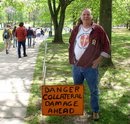 Throughout our time at Kent, we kept crossing paths with fellow members of VVAW, who had a strong presence during the anniversary events. One of these veterans told us how he vividly recalls being in Vietnam when he got the news of the killings. “I just hung my head and sobbed. I was supposed to be in Vietnam defending my country—supposedly fighting for democracy and rights like free speech. And then I found out our soldiers killed students for speaking out against the war we all hated?” (VVAW photos are courtesy of Ward Reilly, FB)
.jpg)
 The Kent State shootings marked a turning point in the anti-war movement. While there is a long history of government violence against minorities and unions, Kent was the first time the weapons targeted white students. The anti-war movement ramped up after Kent State to the point where it shorted the war and thus saved lives. As historian, Howard Zinn, said in an interview in 2007, “I think the war ended because the protests in the United States reached a crescendo, which couldn’t be ignored.” Kent State started the crescendo that stopped the war.
 On May 4, 1970, at Kent State University, in the city of Kent, Ohio, members of the Ohio National Guard fired 67 rounds over a period of 13 seconds, killing four students and wounding nine others, one of whom suffered permanent paralysis. These were unarmed college students who were exercising their constitutional rights to speak their mind, to demonstrate peacefully, and to protest openly against the then recent incursion by US combat forces into Cambodia.
  On Friday, May 1st, 1970, a peaceful demonstration with about 500 students was held at Kent State. The Cambodian Incursion, the draft lottery, the continued escalation of the Vietnam War – all issues being protested against. The crowd dispersed at 1 PM to attend classes, but not until another rally was planned for May 4th. As peaceful, symbolic protests continued, one student burned a copy of the US Constitution. Another burned his draft card.
 The guardsmen generally faced the parking lot which was about 100 yards away. At one point, some of the guardsmen knelt and aimed their weapons toward the parking lot, then stood up again. For a few moments, several guardsmen formed a loose huddle and appeared to be talking to one another. The guardsmen appeared to be unclear as to what to do next. They had cleared the protesters from the Commons area, and many students had left, but many stayed. At the end of about ten minutes, the guardsmen began to retrace their steps back up the hill toward the Commons area.
 At this point, at 12:24 p.m., a number of guardsmen at the top of the hill abruptly turned and fired their M1 Garand rifles at the students. In all, 29 of the 77 guardsmen claimed to have fired their weapons, using a final total of 67 bullets. The shooting was determined to have lasted only 13 seconds, although a New York Times reporter stated that "it appeared to go on, as a solid volley, for perhaps a full minute or a little longer." The question of why the shots were fired remains widely debated.
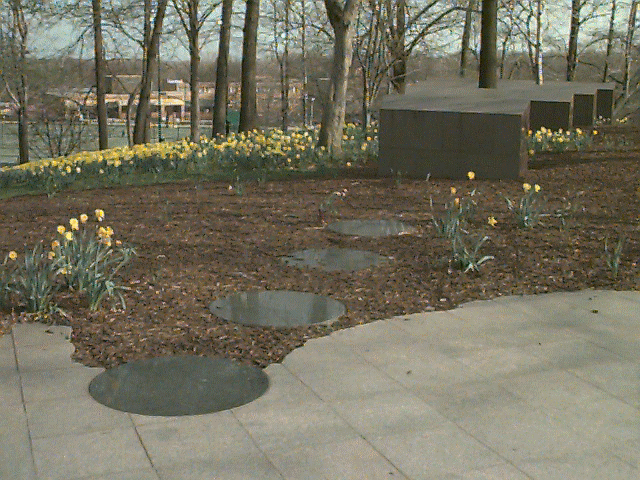 The shootings killed four students and wounded nine. Two of the four students killed, Allison Krause and Jeffrey Miller, had participated in the protest, and the other two, Sandra Scheuer and William Knox Schroeder, had been walking from one class to the next at the time of their deaths. Schroeder was also a member of the campus ROTC chapter. Of those wounded, none was closer than 71 feet to the guardsmen. Of those killed, the nearest (Miller) was 265 feet away, and their average distance from the guardsmen was 345 feet.
 This week, we continue to seek the truth of exactly what happened at Kent State. Noted filmmaker and activist, Michael Moore will be broadcasting live, via his website, the Kent State Truth Tribunal which started yesterday in Kent, Ohio.

.jpg)