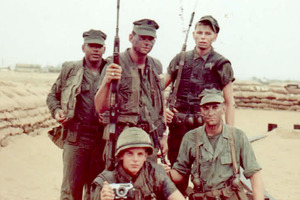
But no adjectives or elevated language could convey the gravity of what Sergeant Camil had experienced during his thirteen month tour, and the extended six months he volunteered to stay on and fight. And however laudatory the officer who evaluated Camil, he couldn’t possibly have known that the 21-year-old sergeant would apply the same skills which made him a good marine to a tireless life of activism.
 Camil’s entrance into the antiwar movement was gradual. When he came home from Vietnam in November 1967 he served two more years in the Marine Corps and had time to adjust from combat.
“I would say that the time was a buffer that saved my life because the conflict resolution skills I learned in Vietnam was to just kill the guy,” Scott Camil said in a recent interview with us.
“We
were all very aggressive when we came home and if somebody spat on me I would
have messed them up. I don’t know any guy that came home and got spit on.”
It
was while he was studying at the University of Florida in Gainesville that
Camil heard Jane Fonda speak at an anti-war rally on the campus and his life
took an unexpected turn.
“I
was throwing a Frisbee, not really paying attention. I just wanted to see Barbarella,”
Camil told us
.
 |
| Getting ready for patrol, Hoi An 1966 |
“[Fonda]
got my attention when she said, ‘This is supposed to be a democracy, and the
people are supposed to be in charge. The people are not getting the truth, and
without true information a democracy cannot function. It cannot live. It’s the
duty of patriotic Vietnam veterans to come forward and tell the truth about
Vietnam because the government is not.’ Well, I was patriotic, I was a Vietnam
veteran, and I knew what we were really doing in Vietnam, and I felt people had a right to know the truth"
During
the rally, Camil gave his contact information to an organizer in front of the
stage taking names of veterans willing to speak truthfully about the war in
Vietnam. Several days later he received a phone call inviting him to Detroit to
participate in the highly publicized Winter Soldier Investigation—a three day
media event sponsored by the Vietnam Veterans against the War (VVAW) intended
to expose war crimes by American troops in Vietnam.
 |
| Dai Loc 1967 |
"My
name is Scott Camil, I was a sergeant attached to Charlie 1-1. I was a forward
observer in Vietnam. I went in right after high school and I’m a student now.
My testimony involves burning villages with civilians in them, the cutting off
of ears, cutting off of heads, torturing of prisoners, throwing prisoners from
helicopters, calling in artillery on villages for games, corpsmen killing
wounded prisoners, napalm dropped on villages, women being raped, women and
children being massacred, CS gas used on people, animals slaughtered, Chieu Hoi
passes rejected and the people holding them shot, bodies thrown off of
helicopters, tear-gassing people for fun, and running civilian vehicles off the
road."
He left Detroit with a renewed sense of self, totally politicized. Songwriter Graham Nash wrote and recorded the song "Oh Camil! (The Winter Soldier)” in tribute and Camil ultimately became a known presence in the anti-war movement, especially on his college campus where he organized demonstrations.
By
1973 he’d made J. Edgar Hoover’s list of dissidents to be "neutralized” for
his conspicuous activities with the VVAW; as a member of the “Gainesville 8” he
stood trial for conspiracy to disrupt the Republican National Convention with
violence and was later hospitalized after a federal narcotics agent nearly shot
him to death.
In a
sense, Camil has always been “under fire.” He has repeatedly endured the
painful rejection of former comrades, been called a traitor by ex-active duty
marines, for once testifying before Senator George McGovern’s committee and in
recent years for his staunch opposition to the wars in Iraq and Afghanistan.
“I
was in two units in Vietnam. First I was in the artillery unit, Alpha Battery,
1/11, or Alpha North, which was my mother unit, and then I was attached out to
an infantry unit. A lot of the guys in that infantry unit who had sons in the
military and were proud of them for going to Iraq stopped inviting me to their
reunions because I accused them of ‘not having learned jack-shit from their
experiences that they would want their children to go to war.’”
Of
the dozens of abbreviated names and acronyms in the Vietnam lexicon used to
describe the enemy, battles, units, and locations there are two words that hold
the most significance for Camil: Alpha North.
Short
for Alpha Battery, 1st Battalion, 11th Marines, it was a fire support base
located just south of Da Nang when Camil arrived on March 24th 1966.
 |
| 1972 poster Winter Soldier Documentary |
As
the “new guy” he was assigned to guard duty for his first three weeks and on
April 17
th was sent with 15 others to
four separate outposts on the camp’s perimeter (four men per outpost) to pull
guard duty. Since Alpha North was in the rear and far enough away from the
fighting, the rules of engagement for those on guard duty were that no weapons
could be loaded and they would not be allowed to fire without permission from
the sergeant of the guard. Grenades were also taped up so that if the pins
accidentally came out no one could get hurt, but because the weather was so
hot, the tape melted to the grenades rendering them useless during the
attack.
“But
I was the kind of person (and still am) for getting in trouble for thinking for
myself. I thought, ‘I’m in Vietnam, I’m in the Marines at war and I’m getting
combat pay,’ so I loaded my rifle. A
trip flare went off to my left front and when all of these hardcore Viet Cong
sappers (suicide unit) with weapons got up to fire and I started shooting.
Chaos erupted everywhere, rockets started blowing things up, people were
shooting.”
The
enemy completely destroyed two of the 105mm howitzers and caused damage to the
ammo and fuel dumps. Out of 90 marines, 5 men had been killed and 28 were
wounded. 40 dead Viet Cong sappers wearing black pajamas lay scattered around
the compound. “The
next morning I knelt down and pulled the ponchos off each of the dead marines-
one of them was my first friend in Vietnam, William Terry "Jake" Main
from Jacksonville, whom I met when I came to the outfit.
“I
remember thinking, ‘This war stuff isn’t going to be as much fun as I thought
it would be’ and that I’m in a place where it’s people’s legitimate job to kill
me… and if I get killed, that is the end. There is no second chance. There is
no King's X. There is no time out. This is really serious and I have to get my
head out of my ass.’ So I made a decision that day that I was going to be
ruthless, brutal, and that I was going to have no empathy. I wanted to live. I
said, ‘kill them all and let God sort them out'. And so, I’m going to err on the side
of safety. If you’re dead, you can’t hurt me or mine. If you’re in free fire
zone and I couldn’t tell the difference between a good guy and a bad guy
whether you’re male, female, child, you’re dead. (who knows if that same person
who’s smiling at you during the day isn’t planting that booby trap at night) I
was going to get them all.”
After
Alpha North’s camp was attacked the battery moved to another compound and Camil
volunteered to be a forward observer with the infantry unit whose activities he
explicitly spoke most about during the Winter Soldier hearings.
What
happened to Camil at Alpha North and afterward is now etched indelibly into the
public record. Camil has told the same stories about what happened to him in
Vietnam ad infinitum in documentaries, interviews, and in the countless
articles about him online. On some levels Camil is no different from other
combat veterans battling Post-Traumatic Stress Disorder and who revisit painful
events in the many self-sealed narratives which have remained frozen for
decades.
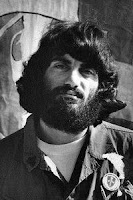 |
| In the ranks of VVAW 1971 |
But
Camil’s war also prefigured his very public world-view and greatly informed his
life in activism which he has maintained at a breathtaking pace. In 1971 he
started the Gainesville chapter of Vietnam Veterans Against the War and in 1987
established the Gainesville Chapter of Veterans for Peace. In the late ‘80s,
and into the ‘90s, Camil represented Veterans for Peace on fact finding
missions to Central America and the Middle East.
Then
in 1994 he returned to Vietnam for the first time since the war to work on the
Vietnam Friendship Village Project—-a nonprofit organization that raises money
in the United States to help support the Vietnam Friendship Village in
Hanoi.
Then
in 1994 he returned to Vietnam for the first time since the war to work on the
Vietnam Friendship Village Project—-a nonprofit organization that raises money
in the United States to help support the Vietnam Friendship Village in
Hanoi.
While
there he told officials that there was one place he had been during the war
that he absolutely needed to go but they balked at his request. After all,
American veterans were always asking to be taken to their old battlefields but
nobody ever knew exactly where they were located. But when the ex-forward
observer took out his old maps from Vietnam he stunned his hosts who then gave
him permission (and a driver) to go where he needed.
“I
went back to this village where our battalion killed 272 people—old men, women
and children.” Camil said. “It’s where I got my first Purple Heart from a
“bouncing betty.” There is a memorial in that village for the people we killed
and I spent one day on my hands and knees and placed three burning incense
sticks at each grave, one of which was a mass grave for 23 children. I made it
a point to tell the people from that village that I was one of the guys who did
this and there was absolutely no hostility against me. So now when I think
about that place I have different pictures in my brain besides the people we
killed and my buddies who bled with me. I have pictures of people who are happy
there now, who are my friends, and who have forgiven me.”
Then
this past year a woman named Bonnie Gallegos, whose brother PFC Robert
Dwain "Arnie" Arnold was killed at Alpha North, decided to organize a
reunion of the unit's surviving veterans in Las Vegas.Camil went and
uncharacteristically took politics off his agenda. It was a chance for him to
write the post-script on a story that has been closed for 46 years.
“There
were some who were afraid that I’d turn it into an anti-war event but the real
reason I wanted to go because there were people I wondered about, who I cared
about,” Camil said. “And for the last 46 years wondered ‘did that person have a
good life?’ or ‘is that person alive?’ "